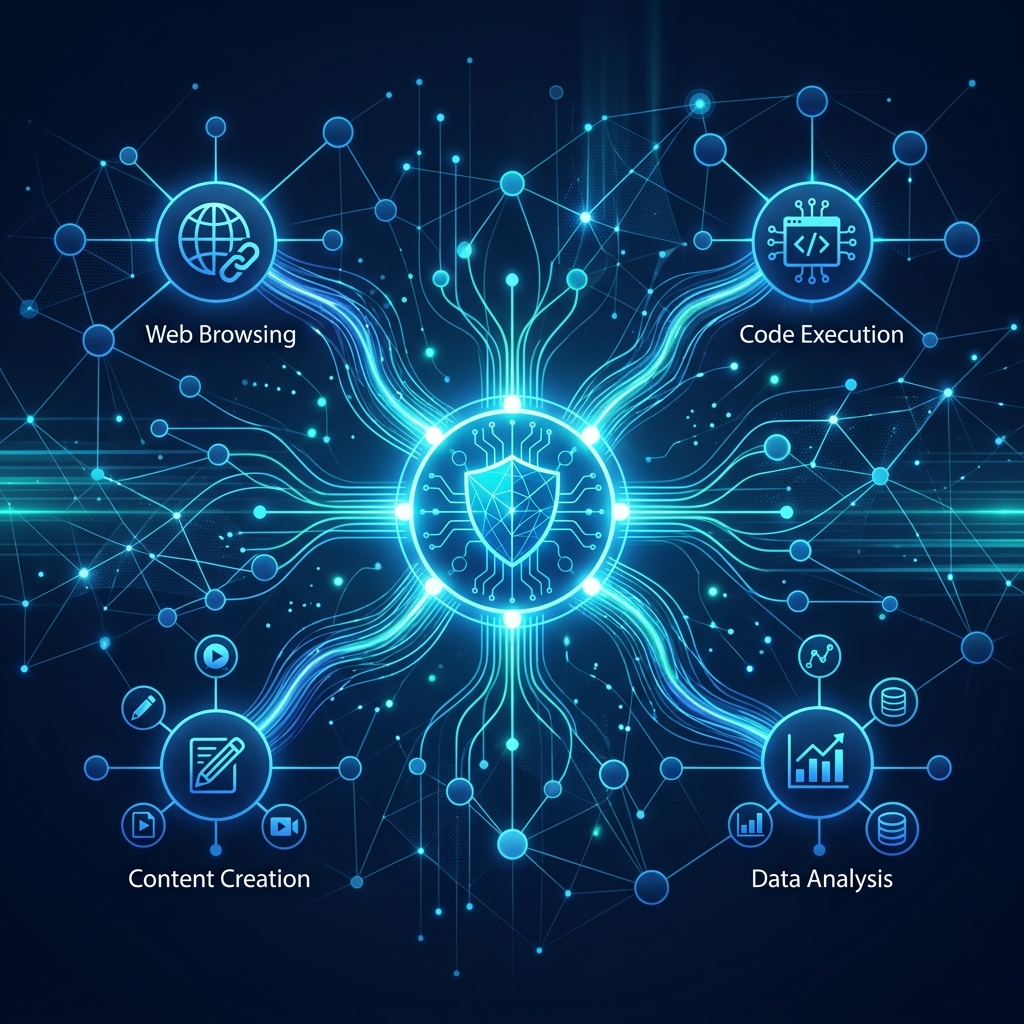
The way we use artificial intelligence is changing faster than most people realise. For the past few years, the dominant model has been simple: you type a prompt, an AI responds, and the conversation ends there. That model — useful as it is — has a ceiling. It cannot plan weeks ahead. It cannot simultaneously browse the web, write code, check a database, and send an email. It cannot adapt mid-task when circumstances change. It waits, passively, for your next instruction.
AI agent orchestration breaks that ceiling entirely.
In 2026, the most competitive businesses are not asking "which AI tool should we use?" They are asking a fundamentally different question: "How do we build a *system* of AI agents that works while we sleep?" This guide answers that question in full — covering the architecture, the leading frameworks, the real-world applications, and the challenges you need to plan for before you deploy.
---
What Is AI Agent Orchestration?
At its core, AI agent orchestration is the discipline of coordinating multiple AI agents — each with a defined role, a specific set of tools, and its own working memory — so that they collaborate on complex tasks without requiring a human to manage each step.
The word "orchestration" is deliberately borrowed from music. In an orchestra, a conductor does not play every instrument. Instead, they coordinate specialists — strings, brass, percussion — each executing their part at the right moment, in the right order, to produce something none of them could achieve alone. AI orchestration works the same way.
A practical example makes this concrete. Imagine you ask an AI system to "research our top three competitors and write a strategic analysis." A single LLM, in one session, would produce something generic based on its training data — outdated, shallow, and likely hallucinated in parts. An orchestrated multi-agent system, by contrast, would:
1. Dispatch a web researcher agent to pull live data from competitor websites, press releases, and LinkedIn 2. Simultaneously dispatch a financial analyst agent to query market databases and extract revenue signals 3. Trigger a sentiment analyst agent to scan recent news coverage and customer reviews 4. Pass all gathered data to a synthesiser agent that cross-references the findings 5. Hand the synthesis to a writer agent that structures the final report to a defined template 6. Run the draft through a fact-checker agent before delivering the output
This entire pipeline can execute in minutes. The equivalent human effort — research, analysis, writing, review — would take days.
---
The Architecture of a Multi-Agent System
Every orchestrated AI system, regardless of the framework used, shares the same fundamental building blocks.
The Orchestrator
The orchestrator is the central intelligence of the system. It receives the high-level objective, decomposes it into a structured plan, assigns sub-tasks to individual agents, monitors their progress, handles failures, and synthesises the final result. The orchestrator is typically powered by the most capable model available — GPT-4o, Claude 3.5 Sonnet, or Gemini 1.5 Pro — because it must reason about the whole problem, not just execute a slice of it.
Sub-Agents
Sub-agents are the specialists. Each one has a narrowly defined job, access to specific tools (a web browser, a code interpreter, a database connector, an API client), and a context window that focuses exclusively on its assigned task. Because sub-agents are scoped to simpler, more predictable work, they can often be powered by smaller, cheaper models — significantly reducing the cost of running the whole system.
Memory Layers
Multi-agent systems need memory at multiple timescales. Short-term memory lives inside the context window of each active agent and holds the working details of the current task. Long-term memory is stored externally — in vector databases like Pinecone or Weaviate — and is retrieved semantically whenever an agent needs relevant background knowledge. Shared memory allows agents to pass information to each other without routing everything through the orchestrator.
Tools
An agent without tools is just a text generator. Tools are what give agents the ability to act in the world. Common tools include web search, code execution sandboxes, email and calendar APIs, CRM connectors, SQL database interfaces, file readers, and image generation models. The richness of an agent's toolset determines what it can actually accomplish.
The Communication Protocol
Agents communicate through structured messages — typically JSON payloads containing the task specification, the result, a status flag, and any error details. Modern frameworks handle this routing automatically, but understanding it matters because the structure of inter-agent communication is where most production bugs originate.
---
Orchestration Patterns
There is no single "right" topology for a multi-agent system. The pattern you choose depends on the nature of the task.
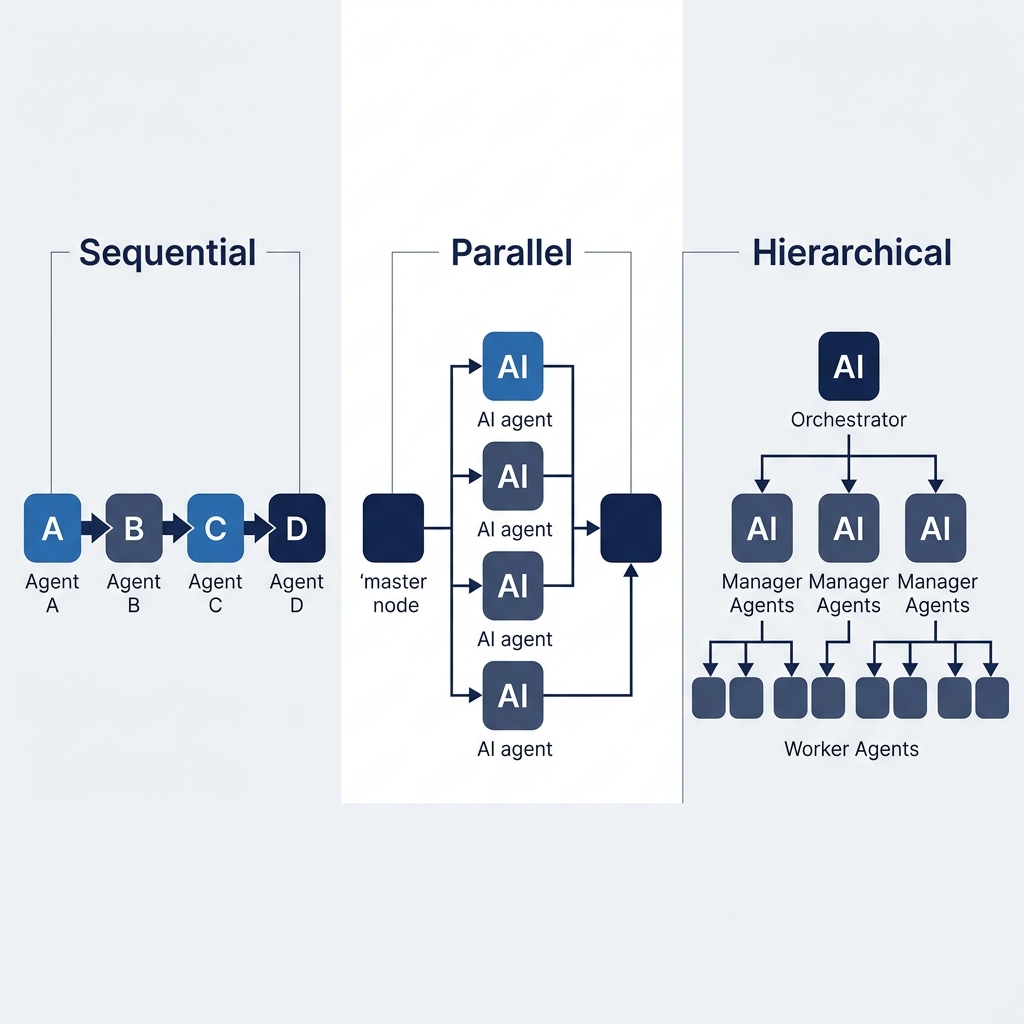
Sequential orchestration chains agents in a strict pipeline, where each agent's output is the next agent's input. This works well for workflows with hard dependencies — you cannot write a draft before the research is complete. The tradeoff is speed: the pipeline is only as fast as its slowest step.
Parallel orchestration fans tasks out to multiple agents running simultaneously and aggregates their outputs at the end. This excels at tasks with independent sub-problems — pulling data from ten sources at once, generating five ad variants, or running parallel code review across multiple modules. Wall-clock time drops dramatically.
Hierarchical orchestration introduces a tier of mid-level "manager" agents between the top-level orchestrator and the worker agents. The orchestrator delegates to managers, managers coordinate workers, workers report back up the chain. This pattern mirrors real organisational structures and scales to genuinely complex, long-horizon tasks — things like running an entire software sprint autonomously, or managing a multi-channel marketing campaign end-to-end.
---
The Top AI Agent Orchestration Frameworks in 2026
The tooling landscape has matured considerably. Here are the frameworks businesses are actually deploying.
LangGraph remains the most widely adopted open-source framework for stateful multi-agent systems. Built on top of LangChain, it models agents as nodes in a directed graph, giving developers explicit control over routing logic, state persistence, and conditional branching. It is the right choice for teams who want maximum control and are comfortable with Python.
CrewAI takes a higher-level approach, abstracting the complexity of agent coordination into intuitive concepts: Agents, Tasks, Crews, and Processes. A developer can define a research crew of three agents in under 50 lines of code. CrewAI has attracted enormous adoption from businesses who want to move fast without deep ML expertise, and its ecosystem of pre-built tools makes it genuinely accessible.
AutoGen from Microsoft specialises in conversational multi-agent patterns, where agents debate, critique, and refine each other's outputs. This adversarial dynamic is particularly effective for complex reasoning tasks where a single agent's first answer is rarely the best one. AutoGen is the framework of choice for AI-assisted software development and research synthesis.
Google Vertex AI Agent Builder provides a fully managed, enterprise-grade platform for deploying agents without managing infrastructure. It integrates natively with Gemini models, Google Search grounding, and the broader Google Cloud ecosystem. For organisations that prioritise compliance, scalability, and managed operations over customisation, Vertex AI is the most production-ready option available.
AWS Bedrock Agents offer similar managed-infrastructure benefits for enterprises already running on AWS. Deep integration with S3, Lambda, DynamoDB, and Knowledge Bases makes it possible to build sophisticated RAG-enhanced agent systems without leaving the AWS console.
Semantic Kernel from Microsoft targets enterprise .NET and Python shops, providing a plugin architecture that makes it straightforward to expose existing business logic as agent-callable functions. It integrates deeply with Azure OpenAI and Microsoft 365, making it the default choice for enterprises in the Microsoft ecosystem.
---
Where Businesses Are Deploying Orchestrated AI Right Now
The use cases that are generating the most measurable ROI in 2026 share a common profile: they involve repetitive, multi-step processes that require integrating multiple data sources and producing a structured output.
Sales intelligence and outreach is one of the highest-value applications. Agent systems research a prospect (company news, funding rounds, tech stack, LinkedIn activity), score the lead based on ICP fit, personalise an outreach sequence, and schedule sends at optimal times — all before a human sales rep even opens their inbox.
Automated content operations allow media companies and agencies to run editorial pipelines at scale. A research agent gathers source material, a writer agent drafts the article, an editor agent applies style guidelines and checks factual claims, and a publishing agent formats and schedules the content. What once required a team of five can be managed by one editor overseeing the pipeline.
Software development acceleration is perhaps the most dramatic application. Coding agent systems like GitHub Copilot Workspace and Devin can take a feature specification, write the implementation across multiple files, run the test suite, identify failures, debug them, and open a pull request — with a human reviewing the final PR rather than writing the first line.
Financial analysis and reporting is where agent orchestration is quietly saving thousands of analyst-hours per month. Agent pipelines pull data from Bloomberg terminals, SEC filings, earnings call transcripts, and internal databases, cross-reference them, and produce board-ready reports with cited sources and data visualisations.
---
The Challenges You Cannot Ignore
Deploying multi-agent systems in production is meaningfully harder than running a single LLM. There are three problems every team encounters.
Error propagation is the most dangerous. When Agent A produces a subtly wrong output, Agent B treats it as ground truth, and the error compounds downstream. By the time the orchestrator synthesises a final answer, the hallucination is buried inside a plausible-sounding document. The solution is to build validation agents into the pipeline at critical handoff points, and to implement human-in-the-loop review for high-stakes decisions.
Cost unpredictability catches teams off guard. A pipeline that makes 200 LLM calls per execution, running 500 times a day, can generate enormous API bills. The mitigation is thoughtful model tiering — use frontier models only where complex reasoning is genuinely required, and route routine, well-defined tasks to smaller, cheaper models.
Observability is difficult by nature. When a 10-agent pipeline produces a bad output, tracing the root cause requires inspecting every agent's input, output, and internal reasoning chain. Tools like LangSmith and Langfuse have emerged specifically to address this, providing full trace visibility, cost attribution per agent, and latency breakdowns — but they need to be instrumented from day one, not retrofitted later.
---
Frequently Asked Questions
What is the difference between an AI agent and a traditional automation script? Traditional automation scripts follow rigid, pre-programmed if-then logic. They break the moment they encounter an unexpected input. An AI agent can reason about novel situations, decide which tool to use, adapt its approach mid-task, and handle ambiguity — none of which a script can do.
Which businesses are too small for AI agent orchestration? None. The scale of the business does not determine whether orchestration is appropriate — the complexity and repetitiveness of the workflow does. A 10-person agency with a labour-intensive client reporting process can benefit enormously from a simple three-agent pipeline, while a large enterprise with straightforward, already-automated operations may not need it at all.
How long does it take to implement a multi-agent system? A focused single-workflow pipeline (e.g., automated lead research) can be scoped, built, and deployed in two to four weeks. Enterprise-grade hierarchical systems with custom integrations and compliance requirements typically take three to six months.
Is AI agent orchestration safe for sensitive business data? It can be, but it requires deliberate architecture decisions: on-premise or VPC-isolated model deployments, encrypted inter-agent communication, strict data access controls per agent, and comprehensive audit logging. Security cannot be an afterthought in agentic systems.
---
The Moment to Act Is Now
AI agent orchestration is not a speculative technology on a roadmap. It is running in production at thousands of companies today, compressing days of skilled work into minutes and creating competitive advantages that are genuinely difficult to replicate without similar systems.
The gap between organisations that have deployed orchestrated AI and those that have not is already material — and it is widening every quarter. The businesses building these systems now are not just saving time. They are structurally re-engineering what it means to operate at scale.
At Bykorp, we design, build, and deploy bespoke AI automation systems — including full multi-agent pipelines — tailored precisely to your business workflows, data environment, and growth objectives. We handle model selection, tool integration, prompt engineering, security architecture, and ongoing optimisation, so your team can focus on the decisions only humans can make.
Talk to Bykorp about building your AI agent system →Ready to grow with Bykorp?
Let's discuss how Bykorp can help your business thrive in the digital age.
Contact Bykorp