When launching a new startup, founders are forced to make dozens of critical decisions daily, usually while managing a tightly restricted runway. Among the most consequential of these early decisions is how to build the company’s digital storefront—the website.
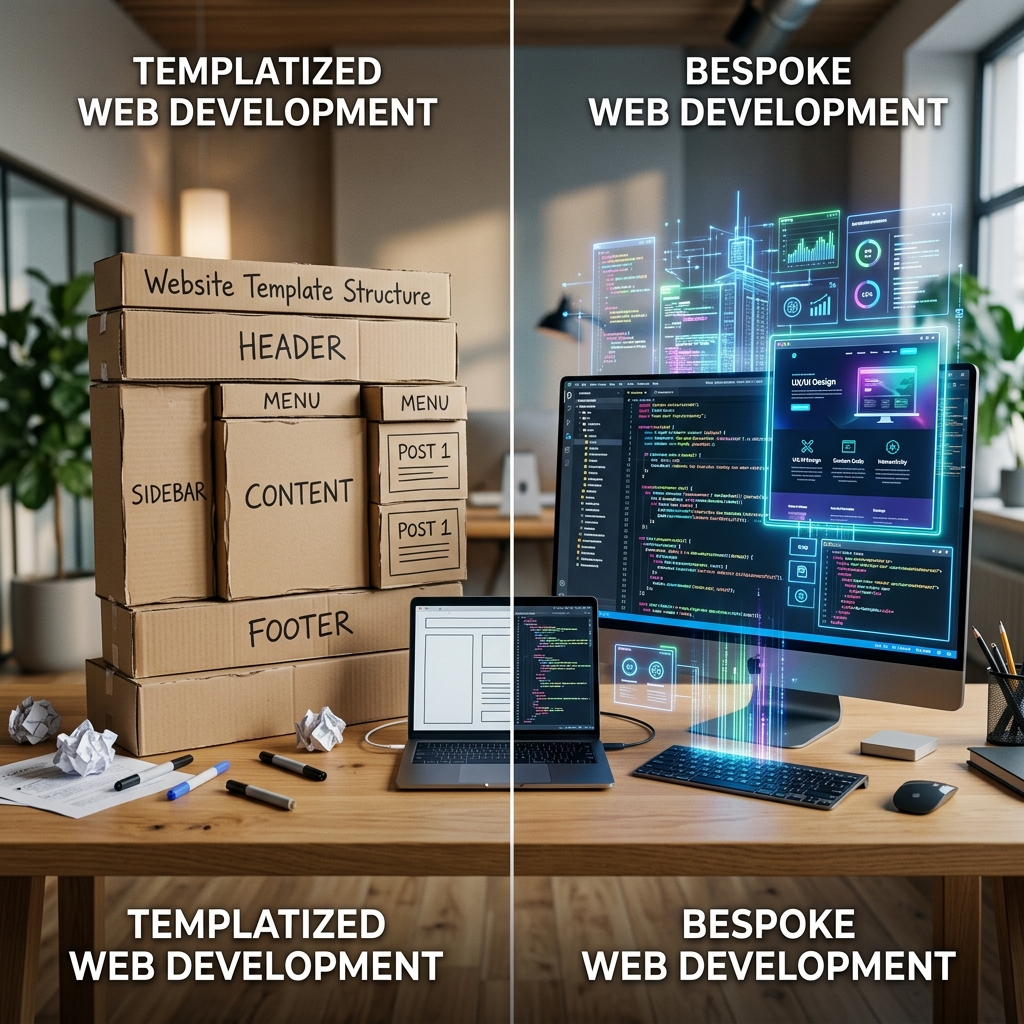
The debate almost always boils down to two distinct paths: Do you purchase a pre-built, $50 WordPress or Webflow template to get to market quickly, or do you invest significantly more capital and time into a fully custom, engineered web architecture?
For a bootstrapped solopreneur testing a minimum viable product (MVP), a template is often a necessary compromise. However, for a funded startup aiming to disrupt an industry, capture enterprise clients, or scale rapidly, relying on a generic template is often a fatal foundational error.
In this comprehensive guide, we will break down the true hidden costs of website templates, the immense strategic advantages of custom web development, and exactly how this foundational decision directly impacts your brand equity, technical scalability, and ultimate revenue trajectory.
The Allure (and Illusion) of the Website Template
The appeal of a pre-built template is obvious and mathematically seductive to early-stage founders. They are incredibly cheap, they allow you to launch a relatively professional-looking site in a matter of days, and they require little to no technical engineering knowledge to deploy. Platforms like Squarespace, Wix, and WordPress theme marketplaces have built billion-dollar empires on this exact value proposition.
However, templates operate on a "one-size-fits-all" philosophy. To appeal to the widest possible audience, template developers cram them full of every conceivable feature, layout option, and third-party plugin integration.
This creates a massive problem: Technical Bloat.
The Performance Penalty of Bloat
When you load a template-based website, the user's browser is forced to download massive libraries of CSS and JavaScript code for sliders, animations, and pop-ups that you might not even be using.As we have discussed extensively in our Next.js performance guides, speed is the ultimate currency of the modern web. If your template takes four seconds to load because it is churning through unnecessary code, your bounce rate will skyrocket. Google will actively penalize your site in organic search rankings, and your cost-per-acquisition (CPA) on paid ads will increase dramatically because users are abandoning the page before the tracking pixel even fires.
The "Frankenstein" UX
Templates are rigid. When your startup eventually needs to add a unique feature—perhaps a custom pricing calculator, a deeply integrated client portal, or a unique interactive product demo—you will quickly find that the template does not support it.Founders attempt to solve this by hacking the template apart, forcefully injecting third-party plugins, and duct-taping code together. The result is a "Frankenstein" user experience (UX) that is buggy, fragile, visually inconsistent, and incredibly frustrating for the end-user.
The Strategic Advantage of Custom Web Development
Custom web development (such as building a bespoke Next.js and React architecture) requires a larger upfront investment of capital and time. However, it is not just an expense; it is the acquisition of a proprietary digital asset designed specifically to solve your exact business problems.
Here is why high-growth startups overwhelmingly pivot to custom architecture as quickly as possible:
1. Absolute Brand Differentiation
In a crowded market, your brand identity is your primary moat. If you use a popular template, your website will subconsciously look and feel exactly like thousands of other businesses, including your direct competitors.A custom-designed website is built from a blank canvas. Every micro-interaction, every typographic scale, and every hover state is meticulously crafted to perfectly align with your unique brand voice. This level of bespoke visual fidelity signals extreme professionalism and establishes immediate, subconscious trust with enterprise buyers and high-ticket clients. You cannot look like a billion-dollar disruptor while wearing a $50 digital suit.
2. Laser-Focused Conversion Rate Optimization (CRO)
A template forces your business model to adapt to its pre-defined layout. A custom website adapts entirely to your business model.With a custom build, the User Experience (UX) is strategically architected around your specific sales funnel. If data shows that your users need a highly visual, multi-step onboarding flow to convert, a custom development team can build exactly that. We can implement hyper-specific heatmapping, run rigorous A/B tests on unique layouts, and eliminate every single point of friction in the user journey. The result is a mathematically optimized conversion machine that a template could never emulate.
3. Infinite Technical Scalability
Startups are designed to scale rapidly. If your marketing campaign goes viral or you are featured in major tech press, your traffic might spike by 10,000% overnight.A bloated, plugin-heavy WordPress template hosted on a standard shared server will crash instantly under that load, costing you the most important PR moment of your company's history.
Custom applications built on modern frameworks (like Next.js) are inherently serverless. As we utilize at Bykorp, these modern architectures deploy directly to the Edge. They automatically and instantaneously scale computing power to handle infinite simultaneous requests, ensuring your site remains blazingly fast whether you have ten visitors or ten million.
4. Enterprise-Grade Security
Templates rely heavily on third-party plugins to function. Every single plugin you install is a potential vulnerability and a backdoor for malicious actors. If a single plugin developer abandons their code and fails to patch a vulnerability, your entire database could be compromised.Custom builds drastically reduce this attack surface. By utilizing custom APIs, server-side rendering, and strict data sanitization protocols, a bespoke application ensures that sensitive user data and proprietary business logic remain heavily fortified against external threats.
Making the Final Decision
So, how do you choose?
If you are a solo founder with zero funding, validating an unproven concept with a tiny local market, use a template. Prove the business model first.
However, if you have secured seed funding, are preparing for a Series A, operate in a highly competitive B2B or tech space, or rely entirely on your website as your primary product or sales engine—you must invest in custom infrastructure.
A template is a rented apartment; you are constrained by the landlord's rules, and you build no equity. A custom website is a house you own, built exactly to your specifications, upon a foundation that will last for decades.
At Bykorp, we specialize in transitioning ambitious startups from fragile templates to robust, high-performance custom architectures. Our engineering and design teams build scalable, lightning-fast digital experiences that differentiate your brand and aggressively drive revenue.
Contact Bykorp today to discuss migrating your startup to a custom, enterprise-grade web architecture.
Ready to grow with Bykorp?
Let's discuss how Bykorp can help your business thrive in the digital age.
Contact Bykorp