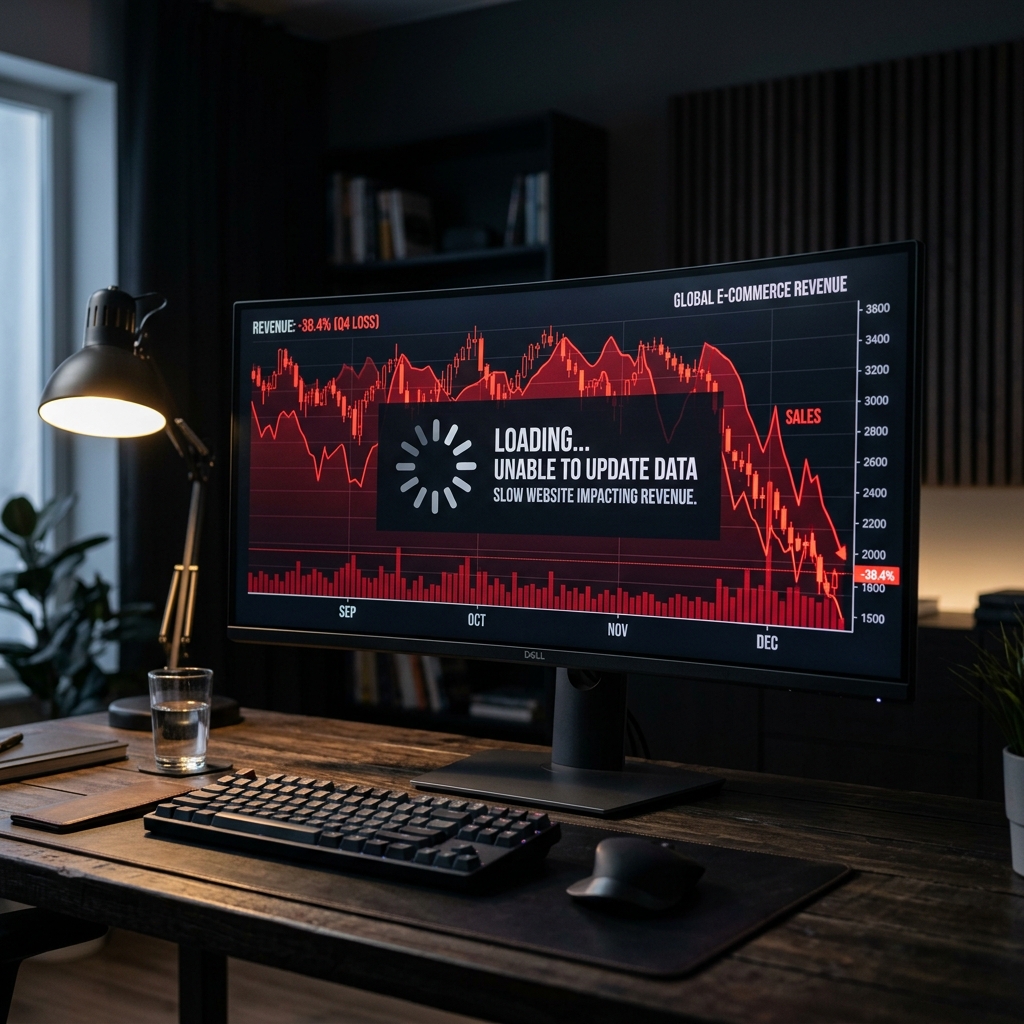
In boardrooms across the globe, discussions about website performance are often relegated to the IT department. Executives view "page load speed" as an abstract, highly technical metric—a minor optimization detail that concerns developers, but has little bearing on high-level corporate strategy.
This is a catastrophic misunderstanding of modern digital economics.
In 2026, a slow website is not a minor technical annoyance; it is a full-blown financial crisis. It is a silent, invisible tax that actively drains your advertising budget, throttles your organic search visibility, and systematically drives your most valuable, high-intent customers directly into the arms of your faster competitors.
If your website takes more than three seconds to load, you do not have a "technology problem." You have a massive, bleeding revenue problem. Here is the undeniable, mathematically proven reality of how website speed directly impacts your bottom line, and exactly how Bykorp engineers high-performance web architecture to stop the bleeding.
The Brutal Mathematics of the Bounce Rate
The modern consumer has been conditioned by massive tech companies (like Amazon, Netflix, and TikTok) to expect absolutely instantaneous digital gratification. As a result, the global tolerance for slow-loading web pages has evaporated entirely.
The correlation between page load time and user abandonment (the "Bounce Rate") is staggering and universally proven by every major data analytics study in the last decade:
Let us apply these statistics to a real-world financial scenario.
Imagine your company spends $10,000 per month on Google Ads, driving 10,000 visitors to a specific landing page (at $1.00 per click). If that landing page takes 5 seconds to load, roughly 90% of those users will hit the "Back" button on their browser before the page even finishes rendering.
You have just set $9,000 of your advertising budget on fire. The user clicked the ad, you were charged by Google, and the user left in frustration before ever seeing your value proposition. A slow website acts as a massive hole in your marketing bucket, rendering your Customer Acquisition Cost (CAC) completely unsustainable.
The SEO Death Spiral: Core Web Vitals
Beyond destroying your paid advertising efficiency, a slow website will systematically dismantle your organic search visibility.
Google's entire business model relies on providing its users with the best possible search experience. If Google sends a user to a website that is slow, broken, or frustrating to use, that user has a negative experience with Google. To protect its product, Google aggressively penalizes slow websites.
In recent years, Google formalized this penalization through the introduction of Core Web Vitals. These are specific, highly technical metrics that measure the real-world user experience of a webpage: 1. Largest Contentful Paint (LCP): How long does it take for the largest piece of content (an image or a block of text) to become visible? (Must be under 2.5 seconds). 2. First Input Delay (FID) / Interaction to Next Paint (INP): How quickly does the website respond when a user clicks a button or taps a link? 3. Cumulative Layout Shift (CLS): Does the page visually jump around as different elements load, causing the user to accidentally click the wrong thing?
If your website fails these Core Web Vitals checks, Google's algorithm will actively suppress your organic rankings, regardless of how expertly written your content is or how many high-quality backlinks you have acquired. You enter an SEO death spiral: your site gets slower, your rankings drop, your organic traffic dries up, and your revenue plummets.
The Conversion Rate Catastrophe
Perhaps the most painful impact of a slow website is its effect on Conversion Rate Optimization (CRO).
Let's assume a highly motivated user actually endures the painful 5-second initial load time of your homepage. The friction has only just begun. If every subsequent action—clicking a product category, adding an item to a cart, or submitting a complex lead-generation form—is met with lag, spinning loading wheels, and delayed feedback, the user's cognitive load and frustration skyrocket.
According to a landmark study by Amazon, every 100 milliseconds of latency (one-tenth of a second) costs them 1% in total sales.
Think about your own digital behavior. Have you ever abandoned an online purchase because the checkout page took too long to process? Have you ever given up on filling out a B2B consultation form because the dropdown menus were lagging?
Speed is the ultimate digital trust signal. A lightning-fast website subconsciously signals to the user that your brand is highly competent, technically sophisticated, and secure. A slow, lagging website subconsciously signals amateurism, lack of resources, and potential security risks.
How Bykorp Engineers Ultimate Performance
Fixing a fundamentally slow website is rarely as simple as "installing a caching plugin" or upgrading your shared hosting plan. In most enterprise scenarios, the underlying architecture of the website is inherently flawed, heavily bloated with legacy code, and structurally incapable of passing modern performance benchmarks.
At Bykorp, we do not apply digital band-aids; we engineer high-performance web architecture from the ground up.
1. The Power of Next.js and Serverless Architecture
As detailed extensively in our web development guides, we aggressively migrate ambitious clients away from legacy monolithic systems (like bloated WordPress installations) and onto modern, highly optimized JavaScript frameworks like Next.js.By utilizing Server-Side Rendering (SSR) and Static Site Generation (SSG), we pre-build your web pages on the server. When a user requests a page, the server does not have to assemble the database queries and the HTML in real-time; it simply serves the pre-built, lightning-fast file instantly.
2. Ruthless Asset Optimization
Images, videos, and heavy third-party tracking scripts are the primary culprits of slow load times. We implement rigorous asset optimization protocols:3. Global Edge Deployment
We deploy our custom web applications to "The Edge." Instead of hosting your website on a single server in one geographic location, we distribute it across a massive, global network of high-performance servers (a Content Delivery Network, or CDN). When a user in London requests your site, it is served directly from a server in London, cutting network latency down to physical minimums.Stop the Bleeding
If you have not rigorously audited your website's performance using professional tools like Google Lighthouse, you are almost certainly flying blind to a massive operational leak in your business.
Every single day that your website remains slow, you are wasting advertising dollars, artificially suppressing your organic search visibility, and actively driving potential clients to your competitors.
Contact Bykorp today to schedule a comprehensive, highly technical performance audit of your digital infrastructure. Let us show you exactly how much revenue you are losing to slow load times, and exactly how our engineering team can rebuild your digital presence into a blazing-fast, revenue-generating machine.
Ready to grow with Bykorp?
Let's discuss how Bykorp can help your business thrive in the digital age.
Contact Bykorp